So, as of yesterday I have 11 flights since rebuild. Yesterday's was only a half hour.
I have several issues to address, but the most pressing is high oil temps. For years, I was a happy camper with oil temps and I strongly felt that a properly cowled and baffled O-200 would not need an oil cooler. Unfortunately, that changed with my new setup and I think the primary issue is with the new composite sump. The old oil tank was a big bulky piece of steel that was a marvelous heat sink.
My new sump doesn't conduct heat for beans and it is more much compact. Now, I get about 20 minutes of flight before the oil is dancing around 225F. (OAT of 57F).
I tried installing one of those finned heat sinks over my oil filter, then built a cooling shroud for it with a 1-1/2" hose leading up to it. Unfortunately, when I flew yesterday, it didn't seem to help a bit.
So now, I guess I'll be exploring the oil cooler option.
Rats.
Saturday, August 22, 2009


Monday, August 03, 2009
A Stuffed Engine Compartment
I was fooling around with the camera and photo editing program to see if I could make some ghost images of the engine compartment. This will help allow me to see where I might have extra room. I found that using Picase Web Albums, I could upload the photos and present slideshows. So here they are. If it seems to bog your computer down, let me know and I'll pull them off. Click of the photos for a larger view.
Looking at the right side of the cowling...
Here is the front view...
And looking at the left...
Looking at the right side of the cowling...
Here is the front view...
And looking at the left...
Baseline Measurements
Today I talked to my friend Harry Hinckley about my plane. Harry is the chief pilot and engineer for Greg Zimmerman's very fast SX300. In this past AventureCup race Harry turned a blistering 298 mph, so when Harry talks, I listen.
When I was talking about where I was in the project, Harry asked me about my baseline numbers. As a Six Sigma Black Belt, I know all about data collection, I just get lazy and don't practice what I know I should do.

So after talking to Harry, I went out and made a ground static run, short test flight, and gathered a little more data.
Total cowling inlets: 22 sq. in
Total cowling outlet 28 sq. in. (kind of estimated)
Static & ground runup
ATIS Temp/dew: 27/16 C = 80/61F
Baro: 30.03"
Dynon Outside Air Temp (OAT) sensor: 84F = 29C
Static RPM 2,400, MAP 30"
Test Altitude: 5,500'
OAT: 59F = 15C, Dynon Density Altitude: 6,700 ft.
WOT RPM: 2,850 - 2,900 RPM MAP 24.5"
IAS: 170 mph, TAS: 188 MPH
Oil temp: 215F

I found some test data from May 23, 2005, also flown at 5,500 feet. At that time, I was able to get about 3,000 RPM and had a corrected airspeed of 199 mph.
I'll refer back to this post, to see what effect my changes make.
When I was talking about where I was in the project, Harry asked me about my baseline numbers. As a Six Sigma Black Belt, I know all about data collection, I just get lazy and don't practice what I know I should do.

So after talking to Harry, I went out and made a ground static run, short test flight, and gathered a little more data.
Total cowling inlets: 22 sq. in
Total cowling outlet 28 sq. in. (kind of estimated)
Static & ground runup
ATIS Temp/dew: 27/16 C = 80/61F
Baro: 30.03"
Dynon Outside Air Temp (OAT) sensor: 84F = 29C
Static RPM 2,400, MAP 30"
Test Altitude: 5,500'
OAT: 59F = 15C, Dynon Density Altitude: 6,700 ft.
WOT RPM: 2,850 - 2,900 RPM MAP 24.5"
IAS: 170 mph, TAS: 188 MPH
Oil temp: 215F

I found some test data from May 23, 2005, also flown at 5,500 feet. At that time, I was able to get about 3,000 RPM and had a corrected airspeed of 199 mph.
I'll refer back to this post, to see what effect my changes make.
Saturday, August 01, 2009
A Few More Flights
I am now up to six flights since the big rebuild. I had a big one yesterday - up for over an hour, which is a lot for someone who is expecting (fearing) the engine to quite any minute. Actually, I'm getting a little more confidence and think this may work out.
Much of the time has been spent fine tuning the mixture mapping for the EC3 and that is getting better. I also took care of the roll trim issue, by adjusting the length of the elevator push rods.
Here is what the mixture mapping looks like. As you can see, I have more tweaking to do. Click on it for a larger image. Get it?

I bounced the first three landings, but the last three have been better, so I am coming along. C-Rod says, even though any landing you can walk away from is a good one - you get extra points if you can reuse the airplane.
I am generally tooling around at lower throttle settings, around 2,300 RPM, since I'm not in a hurry to get anywhere. The oil temperature seems to be holding around 200-205F and I need to work on that.
Today, at wide open throttle (WOT) I got about 2,800RPM. I flew my last AirVenture Cup race at 3,050 RPM, so I have big work there. I am going to try all other means, but I believe the handwriting is on the wall to change back to a straight in-line induction system. Of course that means more design and more fiberglass and more painting. Yeauch.
As far as speeds go, I think I may not be too bad. Today at 3,100 feet, I briefly held 2,620 RPM with 26" MAP and got 159 mph IAS. The Dynon's displayed TAS was 167. I still need to check airspeed calibration, but I think those figures might be a little better than before.
I really need to get the RPMs over 3,000 to see what I have wrought.
Much of the time has been spent fine tuning the mixture mapping for the EC3 and that is getting better. I also took care of the roll trim issue, by adjusting the length of the elevator push rods.
Here is what the mixture mapping looks like. As you can see, I have more tweaking to do. Click on it for a larger image. Get it?

I bounced the first three landings, but the last three have been better, so I am coming along. C-Rod says, even though any landing you can walk away from is a good one - you get extra points if you can reuse the airplane.
I am generally tooling around at lower throttle settings, around 2,300 RPM, since I'm not in a hurry to get anywhere. The oil temperature seems to be holding around 200-205F and I need to work on that.
Today, at wide open throttle (WOT) I got about 2,800RPM. I flew my last AirVenture Cup race at 3,050 RPM, so I have big work there. I am going to try all other means, but I believe the handwriting is on the wall to change back to a straight in-line induction system. Of course that means more design and more fiberglass and more painting. Yeauch.
As far as speeds go, I think I may not be too bad. Today at 3,100 feet, I briefly held 2,620 RPM with 26" MAP and got 159 mph IAS. The Dynon's displayed TAS was 167. I still need to check airspeed calibration, but I think those figures might be a little better than before.
I really need to get the RPMs over 3,000 to see what I have wrought.
Thursday, July 30, 2009
Missing the Big Show

This is the first year I've completely missed Oshkosh, in I don't know how many years. It's kind of a sour grapes pity party, but that's the way it is.
Last year I flew a friend and his C-182 up there, so it wasn't like I wasn't connected or anything, but I realized one of the best things for me was to just hang around the Quickie and see how many moths are drawn to the light.
So, this year I decided if the Quickie couldn't make it, I wouldn't make it. That's completely okay with me, but nothing beats being at Oshkosh with the plane on the flight line, Sandy nearby, and visiting with all the friends I've made over the years.
Next year, for sure.
Wednesday, July 22, 2009
Third Flight
Quick report.
Flew this evening for .6 hrs. That puts me well over an hour now. I just climbed and circled the airport.
Roll trim is still kattywhumpuss, but that's just hardware work. Also I'm not getting enough elevator down, again easily fixable and the two are related.
I started gently fooling around with the mixture mapping in flight. I am using Deem's lamda meter, which is really cool. I didn't go through the whole thing, just making some mixture adjustments when I happened to look at the meter.
I don't have anywhere near the speeds I'm used to, I think the best airspeed I saw was around 160 mph.
I did check out the airspeed/differential pressure. In level flight and throttle at 2,500RPM I was showing about 93 mph. If you look in the table, in the previous post, you will see that is only about 4 inches of water. Not enough, I think. I should probably be getting at least 5 1/2 inches, so that will be something for me to work on.
I'll report back when I know more.
P.S. I apologize to someone. They left a constructive comment and I accidentally hit the reject button and I can't take it back. Sorry. Please post it again and I'll try to not be so clumsy.
Flew this evening for .6 hrs. That puts me well over an hour now. I just climbed and circled the airport.
Roll trim is still kattywhumpuss, but that's just hardware work. Also I'm not getting enough elevator down, again easily fixable and the two are related.
I started gently fooling around with the mixture mapping in flight. I am using Deem's lamda meter, which is really cool. I didn't go through the whole thing, just making some mixture adjustments when I happened to look at the meter.
I don't have anywhere near the speeds I'm used to, I think the best airspeed I saw was around 160 mph.
I did check out the airspeed/differential pressure. In level flight and throttle at 2,500RPM I was showing about 93 mph. If you look in the table, in the previous post, you will see that is only about 4 inches of water. Not enough, I think. I should probably be getting at least 5 1/2 inches, so that will be something for me to work on.
I'll report back when I know more.
P.S. I apologize to someone. They left a constructive comment and I accidentally hit the reject button and I can't take it back. Sorry. Please post it again and I'll try to not be so clumsy.
Starting the de-bugging
Now that I proved that it can fly, I need to get after all the squawks. Right now, the main issues are engine heat and power. Yesterday I went out and:
Regarding item # 5 above. There are a lot of factors about engine cooling and there are several great articles out there if you are willing to search for them.
One of the fundamental things to check for is to make sure that you have an adequate pressure differential between the top of the engine, compared to the bottom of the engine. The engineers like to refer to this as inches of water, as seen in a manometer. Let's say you had no baffling at all. In that case there would be zero pressure differential and zero inches of water.
Lycoming wants to see between 5 1/2 & 6 1/2 inches of water. Since rigging up a manometer can be cumbersome, there is an easier way, using an airspeed indicator. I had an old one laying around so I hooked it up kind of like this (scroll down a bit).
If I don't have enough pressure differential, that should be addressed first. But, if there is enough difference, then I need to go after different things like controlling air flow around a specific component, but first things first.
So looking at the table below, I will be hoping to get about 110 mph on the indicator.
I'll report my results later.
- Adjusted elevator push rod for better roll trim.
- Significantly opened up the path for cowling discharge air.
- Discovered air leak around #2 cylinder. Will repair after next test flight.
- Took care of fuel line chafing on cowl.
- Plumbed in an airspeed indicator to measure cowling pressure differential.
- Hooked up mixture meter so I can observe it in flight. I will continually be checking the fuel/air ration to fine tune the EC3 mixture mapping.
Regarding item # 5 above. There are a lot of factors about engine cooling and there are several great articles out there if you are willing to search for them.
One of the fundamental things to check for is to make sure that you have an adequate pressure differential between the top of the engine, compared to the bottom of the engine. The engineers like to refer to this as inches of water, as seen in a manometer. Let's say you had no baffling at all. In that case there would be zero pressure differential and zero inches of water.
Lycoming wants to see between 5 1/2 & 6 1/2 inches of water. Since rigging up a manometer can be cumbersome, there is an easier way, using an airspeed indicator. I had an old one laying around so I hooked it up kind of like this (scroll down a bit).
If I don't have enough pressure differential, that should be addressed first. But, if there is enough difference, then I need to go after different things like controlling air flow around a specific component, but first things first.
So looking at the table below, I will be hoping to get about 110 mph on the indicator.
| MPH | KNOTS | IN. of H2O | #/IN2 |
| 30 | 26.1 | .44 | .016 |
| 40 | 34.8 | .79 | .028 |
| 50 | 43.5 | 1.23 | .044 |
| 60 | 52.2 | 1.77 | .064 |
| 70 | 60.9 | 2.41 | .087 |
| 80 | 69.6 | 3.15 | .114 |
| 90 | 78.3 | 3.99 | .144 |
| 100 | 87.0 | 4.92 | .178 |
| 110 | 95.7 | 5.95 | .215 |
| 120 | 104.3 | 7.09 | .2558 |
I'll report my results later.
Monday, July 20, 2009
One Small Step for Sam - One Giant Leap for Samkind
Finally. Finally. I got it back in the air. I told Sandy that I flew and she said something like "Whew! O-boy". She sounded just like Walter Cronkite.
I didn't pick the date, it just happened, but my third first flight in the Quickie happily fell on the 40th anniversary of the moon landing. Heady stuff for all.
I always told Sandy, "I'll fly it when it's ready". The to-do list finally got whittled down so there was nothing left to do but fly. I haven't posted my recent struggles, like the primary system going dead for no apparent reason (I blew a critical fuse while tinkering) or the back-up system not working (I somehow had discharged the back-up battery down to 5 volts).
But today, all systems were go for launch and I committed aviation. Twice, in fact.
My good buddy C-Rod brought out his entire A&P inspections class witness the crime, in direct opposition to my general secrecy policy for these events. But It worked out - I just ignored them and went into my secret place. You know, where the Olympians go right before that big track or swimming event.
A parachute was offered, but it turned out there just wasn't room, so I didn't wear it.

It started just fine and I ran it up and down an inactive runway a few times and everything seemed strong. With my straightened tailspring and lengthened cowling, I have lost a fair amount of forward visibility while taxiing, but I'll get used to it.

So I went out to 18L and flew. Must have gotten all of three tenths before the oil really started getting hot and I told the tower I wanted back down.
I bounced the landing a bit, but cut me a break, it has been a year and a half since I flew this critter and all's well that ends well.
My residual adrenalin must have stayed with me for a couple of hours. There are lots of things to work on, trim and cooling, etc, etc., but they will sort out in time and I hope to be going fast again.
I have to make a mention here. On the way back from the airport I got a phone call from my good friend Jim Patillo, who was calling to tell me a Quickie builder, Ron Weiss, had been killed while flying another type of homebuilt (Lancair) out in California. I never met Ron but he did post messages often on the Quickie Builders e-mail list, and we sure hate it when we get those calls. I guess you could say it made today's event somewhat bittersweet.
But anyway, after I calmed down a few hours I went out and committed aviation a second time - I wanted to get a better handle on what my new Dynon instrumentation was telling me.
This time, the engine wasn't quite so hot and I was able to stay up for about four tenths of an hour.
That's enough for now, just remember, there is no higher education than aviation. And hey - Let's be safe out there.
I didn't pick the date, it just happened, but my third first flight in the Quickie happily fell on the 40th anniversary of the moon landing. Heady stuff for all.
I always told Sandy, "I'll fly it when it's ready". The to-do list finally got whittled down so there was nothing left to do but fly. I haven't posted my recent struggles, like the primary system going dead for no apparent reason (I blew a critical fuse while tinkering) or the back-up system not working (I somehow had discharged the back-up battery down to 5 volts).
But today, all systems were go for launch and I committed aviation. Twice, in fact.
My good buddy C-Rod brought out his entire A&P inspections class witness the crime, in direct opposition to my general secrecy policy for these events. But It worked out - I just ignored them and went into my secret place. You know, where the Olympians go right before that big track or swimming event.
A parachute was offered, but it turned out there just wasn't room, so I didn't wear it.

It started just fine and I ran it up and down an inactive runway a few times and everything seemed strong. With my straightened tailspring and lengthened cowling, I have lost a fair amount of forward visibility while taxiing, but I'll get used to it.

So I went out to 18L and flew. Must have gotten all of three tenths before the oil really started getting hot and I told the tower I wanted back down.
I bounced the landing a bit, but cut me a break, it has been a year and a half since I flew this critter and all's well that ends well.
My residual adrenalin must have stayed with me for a couple of hours. There are lots of things to work on, trim and cooling, etc, etc., but they will sort out in time and I hope to be going fast again.
I have to make a mention here. On the way back from the airport I got a phone call from my good friend Jim Patillo, who was calling to tell me a Quickie builder, Ron Weiss, had been killed while flying another type of homebuilt (Lancair) out in California. I never met Ron but he did post messages often on the Quickie Builders e-mail list, and we sure hate it when we get those calls. I guess you could say it made today's event somewhat bittersweet.
But anyway, after I calmed down a few hours I went out and committed aviation a second time - I wanted to get a better handle on what my new Dynon instrumentation was telling me.
This time, the engine wasn't quite so hot and I was able to stay up for about four tenths of an hour.
That's enough for now, just remember, there is no higher education than aviation. And hey - Let's be safe out there.
Friday, July 10, 2009
There is No Joy in Mudville
Rats!
I thought I had it licked. Last night I was getting roughness in the backup system and also the primary was acting up. This morning I went out early and replaced the electronic ignition spark plugs and the engine ran great in all functions! I have been doing a lot of ground running and I have seen this plug fouling before.
I put the cowling on and called the tower and told them I would like some high speed taxis, then possibly a takeoff. Everything seemed fine until I did my run-up at the end of the runway. The primary system was strong, but when I switched to the backup the engine just sputtered and died.
I ran up and down the runway a few times, then tried it again. Same thing. I tried leaning the back-up system, then richening it. Tried all sorts of throttle settings. No joy, so I taxied back to the hangar with my tail hanging between my legs.
Rats! Did I already say that?
So now, I am officially scratching my entrance in the AirVenture Cup race. We're taking the granddaughters on a little vacation today and maybe I can figure it out when I get back.
I'm dumfluxed. I need an expert to come and help me out.
See you in a week or so.
Sam
I thought I had it licked. Last night I was getting roughness in the backup system and also the primary was acting up. This morning I went out early and replaced the electronic ignition spark plugs and the engine ran great in all functions! I have been doing a lot of ground running and I have seen this plug fouling before.
I put the cowling on and called the tower and told them I would like some high speed taxis, then possibly a takeoff. Everything seemed fine until I did my run-up at the end of the runway. The primary system was strong, but when I switched to the backup the engine just sputtered and died.
I ran up and down the runway a few times, then tried it again. Same thing. I tried leaning the back-up system, then richening it. Tried all sorts of throttle settings. No joy, so I taxied back to the hangar with my tail hanging between my legs.
Rats! Did I already say that?
So now, I am officially scratching my entrance in the AirVenture Cup race. We're taking the granddaughters on a little vacation today and maybe I can figure it out when I get back.
I'm dumfluxed. I need an expert to come and help me out.
See you in a week or so.
Sam
Wednesday, July 08, 2009


Sunday, July 05, 2009
Not So Fast, Buddy Boy
Or, should I say "It's not ready, till I say it's ready".
The weight & balance is done, and I was glad to see that it came in at 696 pounds, even with all the stuff I added, including extra batteries, heavier paint job, and TWO paint jobs.
I thought I just needed to get the vinyl lettering applied and a few more little items, when go taxi. But, why should it be that easy?
I thought I'd celebrate having the canopy on by running the engine a little. I got it up to 2,400 RPM, then it started getting rough again. What's the deal with that?
Rats.
Maybe that sensor bracket is still vibrating a little. I have a plan for that. Maybe the mixture still needs tweaking. I dunno.
We'll see tomorrow.
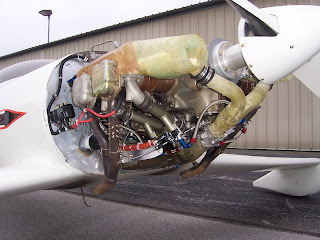
Anyway, here's some photos of the mostly complete engine installation.



 Mixture look a little rich?
The weight & balance is done, and I was glad to see that it came in at 696 pounds, even with all the stuff I added, including extra batteries, heavier paint job, and TWO paint jobs.
I thought I just needed to get the vinyl lettering applied and a few more little items, when go taxi. But, why should it be that easy?
I thought I'd celebrate having the canopy on by running the engine a little. I got it up to 2,400 RPM, then it started getting rough again. What's the deal with that?
Rats.
Maybe that sensor bracket is still vibrating a little. I have a plan for that. Maybe the mixture still needs tweaking. I dunno.
We'll see tomorrow.
Anyway, here's some photos of the mostly complete engine installation.


 Mixture look a little rich?
Friday, July 03, 2009
So Close I Can Taste It
I am 90% though my annual condition checklist and the thing is close to being ready.
Yesterday, I hauled it over to AvTech for weight & balance. I had the help of the instructor, Karen and two A&P students, Tom & Colin. I forgot to use my camera, but Colin grabbed these with his cell phone. Thanks folks!

I was happily surprised to see it come in under 700 pounds, 696 pounds, to be exact. I was afraid I would be in the 725 range, so 696 is good, considering all the stuff I've added. We weighed all possible combinations; empty, main tank, header tank, aux tank, pilot installed, etc. I'll figure all the arms & moments later.

Just to remind me that nothing should happen too easily, I intended to taxi the Q-200 over to AvTech for the weigh-in. Unfortunately, there was interference between my air induction tube and the cowling, which resulted in causing the lower cowl to bind against the spinner. So, today I'll have to modify the tube to better fit the cowl, blah, blah, blah.
Yesterday, I hauled it over to AvTech for weight & balance. I had the help of the instructor, Karen and two A&P students, Tom & Colin. I forgot to use my camera, but Colin grabbed these with his cell phone. Thanks folks!

I was happily surprised to see it come in under 700 pounds, 696 pounds, to be exact. I was afraid I would be in the 725 range, so 696 is good, considering all the stuff I've added. We weighed all possible combinations; empty, main tank, header tank, aux tank, pilot installed, etc. I'll figure all the arms & moments later.

Just to remind me that nothing should happen too easily, I intended to taxi the Q-200 over to AvTech for the weigh-in. Unfortunately, there was interference between my air induction tube and the cowling, which resulted in causing the lower cowl to bind against the spinner. So, today I'll have to modify the tube to better fit the cowl, blah, blah, blah.
Monday, June 22, 2009
Happy Anniversary
Today, June 22, 2009, is the 10th anniversary of my one-day trip across the U.S.A. in my Q-200. I guess it doesn't seem like ten years, then again, a lot has transpired since then (the best of which, was marrying Sandy).
 Here is the link to the whole story Trip Across USA It's a pretty long read, so I suggest making yourself comfortable and pouring a cup of coffee first.
Here is the radar capture for June 22, 1999 - about mid-day. As you can see I had a bit of a time picking through Oklahoma.

It really is a shame that I can't celebrate properly and go fly today, but alas, I am still trying to hash out engine problems. (I think the engine now has more power than with the old system, I just can't get my back-up fuel injection to work yet). I guess I'll commemorate it by going to the hangar and giving the old girl a pat on the vertical fin.
This little plane has been one of the most rewarding, satisfying, challenging, expensive, hair pulling, bleeding, frustrating, and funnest things that I have ever been involved with.
Here's to my little Quickie!
Here is the link to the whole story Trip Across USA It's a pretty long read, so I suggest making yourself comfortable and pouring a cup of coffee first.Here is the radar capture for June 22, 1999 - about mid-day. As you can see I had a bit of a time picking through Oklahoma.

It really is a shame that I can't celebrate properly and go fly today, but alas, I am still trying to hash out engine problems. (I think the engine now has more power than with the old system, I just can't get my back-up fuel injection to work yet). I guess I'll commemorate it by going to the hangar and giving the old girl a pat on the vertical fin.
This little plane has been one of the most rewarding, satisfying, challenging, expensive, hair pulling, bleeding, frustrating, and funnest things that I have ever been involved with.
Here's to my little Quickie!
Thursday, June 11, 2009
I Got It ! - I Get By With a Little Help From My Friends
Finally... I know what was causing my woes (besides dain bramage). How long have I been working on this rough engine problem? Two months? Three months? Four?
The problem was finally traced to vibration of the bracket that holds the pickup sensors.
Now, how did I come to that conclusion?
Several of my advisers suggested getting my hands on an oscilloscope (see the previous post). After I sent out the results of that test, two experts said that my problem was the variation in amplitude in the signal - not a phase shift, and was most likely caused by vibration.

I got hold of Don Bartlett (who doesn't like me very much) and he welded a couple of gussets onto the new bracket made by Phil Lankford and Jeff Doddridge, in California.

 When I first fired it up, I could tell that things were better, but still not 100%. It ran well on the mag, but not on the electronic ignition, but the fuel injection seemed fine. Fortunately, I had experience with this and figured it was just dirty spark plugs.
I let the thing cool off for an hour, pulled and cleaned the automotive plugs, then stuck them back in.
When I fired it up it ran just great! Wow!!! Did I say great? I really meant fantastic! I brought it up all the way to 2,370 RPM, which I hadn't seen in a long, long time! There was still a slight roughness when running on the electronic ignition, but nothing like before. I think I need some bracing of the sensor bracket, but at least I know what to do!
I want to thank all you guys who were helping me on this frustrating, teeth gnashing, hair pulling episode. I'm going to take a couple of days off for a Hoskins family reunion, but I'll be back at it on Tuesday.
Thanks again, all!
The problem was finally traced to vibration of the bracket that holds the pickup sensors.
Now, how did I come to that conclusion?
Several of my advisers suggested getting my hands on an oscilloscope (see the previous post). After I sent out the results of that test, two experts said that my problem was the variation in amplitude in the signal - not a phase shift, and was most likely caused by vibration.

I got hold of Don Bartlett (who doesn't like me very much) and he welded a couple of gussets onto the new bracket made by Phil Lankford and Jeff Doddridge, in California.

 When I first fired it up, I could tell that things were better, but still not 100%. It ran well on the mag, but not on the electronic ignition, but the fuel injection seemed fine. Fortunately, I had experience with this and figured it was just dirty spark plugs.
I let the thing cool off for an hour, pulled and cleaned the automotive plugs, then stuck them back in.
When I fired it up it ran just great! Wow!!! Did I say great? I really meant fantastic! I brought it up all the way to 2,370 RPM, which I hadn't seen in a long, long time! There was still a slight roughness when running on the electronic ignition, but nothing like before. I think I need some bracing of the sensor bracket, but at least I know what to do!
I want to thank all you guys who were helping me on this frustrating, teeth gnashing, hair pulling episode. I'm going to take a couple of days off for a Hoskins family reunion, but I'll be back at it on Tuesday.
Thanks again, all!
More chasing
Please take a look at these two sorrowful pages of sketches of today's oscilloscope output.
The engine always starts easily and idles very smoothly. Roughness starts around 1,800 RPM. Misfiring is very pronounced, really shakes the engine, and the exhaust is momentarily black.
Page 1.
First wave is pretty much what it looks like with both the 6" and 7 1/2" wheel, at idle. With the 7 1/2" wheel there is a little more of a hump in the middle of the trigger wave. The peak-to-peak amplitude is pretty even and is about 4 volts p-p.
2nd wave. This is what it looks around 2,000 RPM. Notice that the amplitude varies greatly, from about 3 V to 7.5 V p-p. We tried adjusting the air gap from .015 to .060 and didn't see a change here. We thought maybe the variations in amplitude might be from the prop bolts and flange lugs. Just speculation.
3rd wave. Another sketch at high throttle. Here, I tried to include the trigger wave. The trigger wave, at higher RPMs, always had a greater p-p voltage than any other part of the wave, while at idle, the trigger wave was the same.

Page 2.
There always is a consistent phase shift (skipping a tooth?) at any speed. In the sketch, I am attempting to show how it would bounce back and forth. We feel this is a key issue, but have no idea why it is occurring.
We also saw that the amplitude of the wave is pretty even at low RPMs, but at higher revs the amplitude varies a lot. Click on the sketches to better read the voltage ranges.

Other things we tried and noticed:
Changed from 1 1/2" to 6" wheel. no change seen on scope.
Removed the prop bolt closest to the trigger gap. - no change
Tried a smaller diameter sensor. - a little smoother.
Degaussed the crankshaft flange. - no change.
Ran on the single magneto only. - a little smoother.
An automotive timing light flashes consistently at low RPMs, but becomes intermittent, in sync with misfiring, at higher speeds.
Installed the 6" wheel and used the 7-1/2" sensor mount bracket. This caused the sensor to kind of be extended way out from the aluminum bracket. No effect.
I sent these sketches to Tracy Crook, at RWS and he thinks that the change in amplitude is the source of the problem and what I perceived as a "phase shift" is not an issue. Given that, I will be concentrating on eliminating all vibration in the sensor mount bracket.
Sam
The engine always starts easily and idles very smoothly. Roughness starts around 1,800 RPM. Misfiring is very pronounced, really shakes the engine, and the exhaust is momentarily black.
Page 1.
First wave is pretty much what it looks like with both the 6" and 7 1/2" wheel, at idle. With the 7 1/2" wheel there is a little more of a hump in the middle of the trigger wave. The peak-to-peak amplitude is pretty even and is about 4 volts p-p.
2nd wave. This is what it looks around 2,000 RPM. Notice that the amplitude varies greatly, from about 3 V to 7.5 V p-p. We tried adjusting the air gap from .015 to .060 and didn't see a change here. We thought maybe the variations in amplitude might be from the prop bolts and flange lugs. Just speculation.
3rd wave. Another sketch at high throttle. Here, I tried to include the trigger wave. The trigger wave, at higher RPMs, always had a greater p-p voltage than any other part of the wave, while at idle, the trigger wave was the same.

Page 2.
There always is a consistent phase shift (skipping a tooth?) at any speed. In the sketch, I am attempting to show how it would bounce back and forth. We feel this is a key issue, but have no idea why it is occurring.
We also saw that the amplitude of the wave is pretty even at low RPMs, but at higher revs the amplitude varies a lot. Click on the sketches to better read the voltage ranges.

Other things we tried and noticed:
Changed from 1 1/2" to 6" wheel. no change seen on scope.
Removed the prop bolt closest to the trigger gap. - no change
Tried a smaller diameter sensor. - a little smoother.
Degaussed the crankshaft flange. - no change.
Ran on the single magneto only. - a little smoother.
An automotive timing light flashes consistently at low RPMs, but becomes intermittent, in sync with misfiring, at higher speeds.
Installed the 6" wheel and used the 7-1/2" sensor mount bracket. This caused the sensor to kind of be extended way out from the aluminum bracket. No effect.
I sent these sketches to Tracy Crook, at RWS and he thinks that the change in amplitude is the source of the problem and what I perceived as a "phase shift" is not an issue. Given that, I will be concentrating on eliminating all vibration in the sensor mount bracket.
Sam
Tuesday, June 09, 2009
Chasing the Noise
I have been corresponding with several of you and thought I'd put a week-end summary into one post. First off, I'd like to thank all of you for your help and patience while I'm going at this problem.
These things had a positive effect:
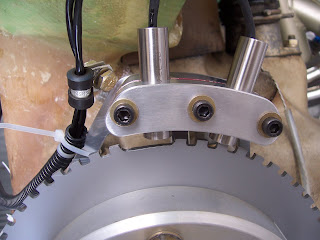
 Changing from a 6" trigger wheel to a 7-1/2" trigger wheel (photo attached), and sensor mounting brackets.
These things had a negative effect:
These things had a positive effect:
- Temporarily replacing the 1/2" VRS sensor with an old 3/8" sensor. Ran a little better.
- Centering the sensor over the trigger teeth. Got another 200 RPM and noticeably smoother.
 Changing from a 6" trigger wheel to a 7-1/2" trigger wheel (photo attached), and sensor mounting brackets.
- Adjusting air gap from .030" to .055"

These things had a negative effect:
- Swapping the position of the primary and backup VRS sensors
- "Dressing up" the two tooth gap in the 7 1/2" trigger wheel. Actually, this was a bonehead move. I'm going to attempt repair it by having a pal fill it in with weld, then reduce it, so it pretty well matches the gap on the 6" wheel. The original configuration may help alleviate the phenomenon known as "phantom tooth".
- Swapping my standard trigger wheel with Lynn French's aluminum bowl and trigger wheel setup.
- When the engine is set at 6 deg. ATC, the primary sensor is directly over the first tooth in the gap. (photo attached shows the engine set exactly at TDC.).
- The air gap remains consistent all around the wheel, within a couple of thousandths.
- The engine starts easily and idles smoothly.
- When at about 700 RPM, the measured timing is around 38 deg. BTDC
- When running at full throttle (2,100 for now) the timing is about 25 deg. BTDC
- At high RPMs, the automotive style timing light flashes quite intermittently at the same time the engine starts missing, indicating, to me, that the signal is getting interference.
- Engine now runs pretty will up to about 1,900 - 2,000 RPM
- Borrow an oscilloscope to view the VRS sensor signal.
- Repair the trigger wheel.
- Inquire into getting a duplicate bowl, trigger wheel and mounting bracket ala Lynn French.
Friday, June 05, 2009
Still Not Right
I am so frustrated. I just can't get the engine to run right. I started with a 6" trigger wheel and after much gnashing of teeth, I borrowed Lynn Frenches setup. I installed his parts, using my sensors, and the engine ran great. That much I know.
I figured my sensors were picking up noise from the rotating prop bolts and I hoped that a larger trigger wheel would help. (Please see the photos in earlier posts). I got a 7-1/2" wheel and had it modified by Phil Lankford and his buddy Jeff.
 I didn't want to copy exactly what Lynn did, since he has a V-belt on his prop hub to drive an alternator. My alternator is on the pad on the accessory case.
Here's a couple pf photos of Phil & Jeff's parts.


I do have a couple of smaller diameter, and very used, electromotive sensors and I'll try rigging them up tomorrow, just to see if that makes any difference.
This sucks. Any comments, please?
I figured my sensors were picking up noise from the rotating prop bolts and I hoped that a larger trigger wheel would help. (Please see the photos in earlier posts). I got a 7-1/2" wheel and had it modified by Phil Lankford and his buddy Jeff.
 I didn't want to copy exactly what Lynn did, since he has a V-belt on his prop hub to drive an alternator. My alternator is on the pad on the accessory case.
Here's a couple pf photos of Phil & Jeff's parts.


I do have a couple of smaller diameter, and very used, electromotive sensors and I'll try rigging them up tomorrow, just to see if that makes any difference.
This sucks. Any comments, please?
Sunday, May 24, 2009
Plane Progress - Slowed to a Crawl
Okay, Sam... What's the latest? Are you close to flying again?
Well, I am closer than before. Phil Lankford, in the San Diego area is working hard to get me a new trigger wheel and mounting bracket worked up. That should show up within a couple of days.
The new Bob Archer com antenna is installed, as is the remote compass for the Dynon D180.

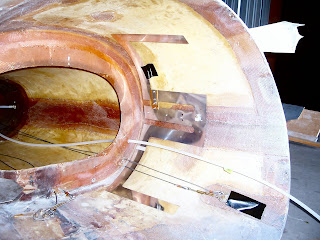

Since I have gotten my system back-up battery installed, I should be able to permanently install the tail cone today or tomorrow.
My back-up fuel injection system is still buggy, but I have to get the engine running again before I can try that out.
So yes, I am getting close. When I get all the pieces back on and working I'll go through my entire Annual Condition Inspection checklist and make sure that I haven't left anything out.
Well, I am closer than before. Phil Lankford, in the San Diego area is working hard to get me a new trigger wheel and mounting bracket worked up. That should show up within a couple of days.
The new Bob Archer com antenna is installed, as is the remote compass for the Dynon D180.


Since I have gotten my system back-up battery installed, I should be able to permanently install the tail cone today or tomorrow.
My back-up fuel injection system is still buggy, but I have to get the engine running again before I can try that out.
So yes, I am getting close. When I get all the pieces back on and working I'll go through my entire Annual Condition Inspection checklist and make sure that I haven't left anything out.
One Reason Why Progress Has Slowed Down
On May 8th, a huge storm blew through southern Illinois. It wasn't just a thunderstorm, it wasn't an inland hurricane, it wasn't a tornado. It was a derecho, a term I don't recall hearing before. Read about it here: http://en.wikipedia.org/wiki/Derecho

I drove through the first wave as I left Murphysboro. I was half way to an airshow in Branson when Sandy called and told me they were getting blasted by the second wave, which the local weather guy called "the head of the comma". There were sustained winds of 90 mph and gusts over 100 mph.

Here is a technical description of the storm. Scroll down to May 10. http://www.weather.com/blog/weather/?from=blogredirect%3f

Here are a bunch of photos showing the impact. http://www.flickr.com/photos/thesouthern sets/72157618012419861/show/
We were without power for 6 days. Well technically, Sandy was without power for 6 days. I only was unconvinced for three nights because the first four I was staying in the Hilton in Branson.
Thousands of trees down, perhaps 2,000 utility poles broken and hundreds of utility workers from as far as Florida and Pennsylvania came in to clean up the mess.
We lucked out. Just a little damage to the gutter on the garage and a few tree limbs.
The big question is; How can we live in southern Illinois without a basement or storm shelter? How crazy is that?
Our house sits in what was the path of the 1925 Tri State Tornado, the worst tornado the nation has ever seen. http://en.wikipedia.org/wiki/Tri-State_Tornado Take a look at the photo of Longfellow School on the Wikipedia page. They never rebuilt the school but converted the land. Longfellow Park is about three blocks from our home.
While there was damage to some buildings at the Southern Illinois Airport, MDH, the T-hangars and the planes within them were unscathed.

I drove through the first wave as I left Murphysboro. I was half way to an airshow in Branson when Sandy called and told me they were getting blasted by the second wave, which the local weather guy called "the head of the comma". There were sustained winds of 90 mph and gusts over 100 mph.

Here is a technical description of the storm. Scroll down to May 10. http://www.weather.com/blog/

Here are a bunch of photos showing the impact. http://www.flickr.com/photos/thesouthern sets/72157618012419861/show/
We were without power for 6 days. Well technically, Sandy was without power for 6 days. I only was unconvinced for three nights because the first four I was staying in the Hilton in Branson.
Thousands of trees down, perhaps 2,000 utility poles broken and hundreds of utility workers from as far as Florida and Pennsylvania came in to clean up the mess.
We lucked out. Just a little damage to the gutter on the garage and a few tree limbs.
The big question is; How can we live in southern Illinois without a basement or storm shelter? How crazy is that?
Our house sits in what was the path of the 1925 Tri State Tornado, the worst tornado the nation has ever seen. http://en.wikipedia.org/wiki/Tri-State_Tornado Take a look at the photo of Longfellow School on the Wikipedia page. They never rebuilt the school but converted the land. Longfellow Park is about three blocks from our home.
While there was damage to some buildings at the Southern Illinois Airport, MDH, the T-hangars and the planes within them were unscathed.
Tuesday, April 21, 2009
I Finally Figured It Out
That's what my dad always used to say, "I finally figured it out". He was always talking about the meaning of life. In my case, I just want to figure out how to make the damn engine run.
Thanks to Lynn French, I definitely know the ignition problem is due to my trigger wheel and sensor assembly. Lynn was kind enough to lend me his parts, while his engine is down, and I bolted it on this afternoon. Lynn has the 7" trigger wheel, while I have the 6". I used my existing sensor and wiring.
The engine fired up just fine, as always. After it warmed up I ran it all the way to 2,320 RPM. I haven't seen the engine turn that fast and smooth in a year and a half. While I was at WOT I switched off the mag and the engine didn't miss a beat.
Here are some photos of Lynn's trigger assembly mounted on my plane. Compare them with my installation in my previous post, dated April 19.

So, without a doubt, the smaller wheel must be causing me to pick up noise from the crank flange and prop bolts.
That's the good news.
Now, I have to figure out what to do about it. My first inclination is to see if I can find a different sensor and use the existing wheel. I have a lot of $$$ in that trigger wheel, and looking at Lynn's parts, I'm sure he even has far more machining than mine. I know a rep for an industrial sensor company and I'll give him a call tomorrow.

Maybe I could use an aluminum plate, with the embedded magnets, like Klaus uses. I would have to know if that type of Hall Effect device would work with the EC3.


Any other ideas?
Thanks to Lynn French, I definitely know the ignition problem is due to my trigger wheel and sensor assembly. Lynn was kind enough to lend me his parts, while his engine is down, and I bolted it on this afternoon. Lynn has the 7" trigger wheel, while I have the 6". I used my existing sensor and wiring.
The engine fired up just fine, as always. After it warmed up I ran it all the way to 2,320 RPM. I haven't seen the engine turn that fast and smooth in a year and a half. While I was at WOT I switched off the mag and the engine didn't miss a beat.
Here are some photos of Lynn's trigger assembly mounted on my plane. Compare them with my installation in my previous post, dated April 19.

So, without a doubt, the smaller wheel must be causing me to pick up noise from the crank flange and prop bolts.
That's the good news.
Now, I have to figure out what to do about it. My first inclination is to see if I can find a different sensor and use the existing wheel. I have a lot of $$$ in that trigger wheel, and looking at Lynn's parts, I'm sure he even has far more machining than mine. I know a rep for an industrial sensor company and I'll give him a call tomorrow.

Maybe I could use an aluminum plate, with the embedded magnets, like Klaus uses. I would have to know if that type of Hall Effect device would work with the EC3.


Any other ideas?
Subscribe to:
Posts (Atom)